


Key Takeaways
- Motorcyclists in Las Vegas are at a significantly higher risk of severe injury or fatality compared to car occupants.
- Lack of protective barriers, visibility issues, and greater vulnerability to road hazards contribute to the heightened risks for motorcyclists.
- Preventive measures, such as the use of proper safety gear and adherence to traffic laws, can help reduce the severity of accidents.
- Policy changes and public awareness campaigns are essential for improving road safety for all users in Las Vegas.
Table of Contents
- Introduction
- Statistical Overview of Accidents in Las Vegas
- Factors Contributing to Injury Severity in Motorcycle Accidents
- Comparative Analysis: Motorcycle vs. Car Accidents
- Common Injuries Sustained
- Preventive Measures and Safety Recommendations
- Conclusion
Introduction
Las Vegas is famous for its energetic atmosphere and crowded streets, but this vibrant city also experiences a high number of traffic accidents each year. Among vehicle crashes, motorcycle and car accidents are particularly noteworthy for their frequency and the distinct differences in injury severity they entail. While increasing awareness is critical for both riders and drivers, making informed safety choices often begins with understanding how each type of accident affects those involved. For individuals seeking legal assistance after an accident, Brian Boyer Injury & Car Accident Lawyer Las Vegas provides guidance and representation to help protect rights and pursue compensation.
Examining why injuries are typically more severe in motorcycle accidents compared to car crashes can help shape better policies and encourage responsible behavior on the road. As Nevada and Las Vegas in particular strive to reduce injuries and fatalities, understanding these differences becomes even more critical for public safety.
Statistical Overview of Accidents in Las Vegas
Recent statistics illustrate an urgent concern for motorcyclists in Las Vegas. In 2025 alone, there was a staggering 40 percent increase in motorcycle-related fatalities by mid-April compared to the prior year, with 14 motorcyclists losing their lives in that brief span. This spike in fatalities underscores the dangers faced by those who choose two wheels over four. In comparison, while car accidents continue to be common, the fatality rate for car occupants has not increased similarly, pointing to the effectiveness of automotive safety features and highlighting ongoing risks for motorcyclists.
According to the National Highway Traffic Safety Administration (NHTSA), nationwide data also reveals that motorcyclists are far more vulnerable in any crash scenario. These persistent disparities underscore the need for targeted public safety campaigns and ongoing research into the specific hazards faced by Las Vegas drivers and riders. For more crash and traffic safety statistics, you can visit the NHTSA’s Fatality Analysis Reporting System.
Factors Contributing to Injury Severity in Motorcycle Accidents
Several contributing factors explain why motorcycle accident injuries tend to be more severe:
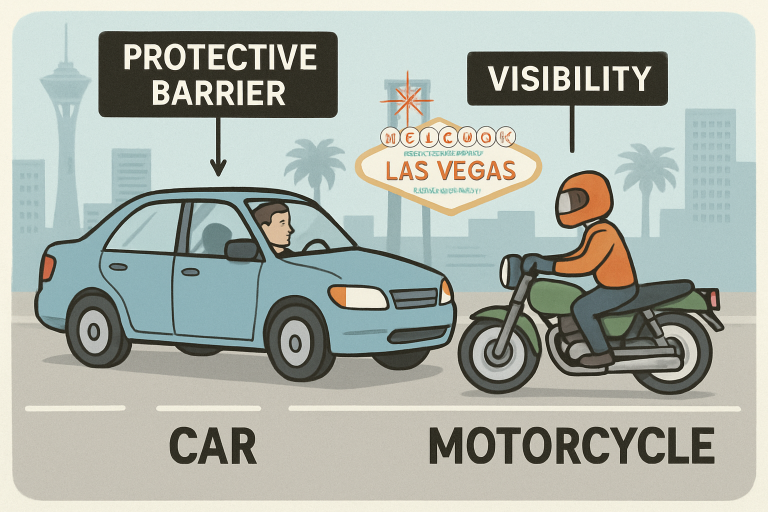
- Lack of Protective Barriers: Motorcycles provide little physical protection for riders. Unlike cars, which have frames, airbags, and seat belts to absorb impact, motorcycles leave riders directly exposed in a collision.
- Visibility Issues: Motorcycles are smaller and less visible, especially in heavy traffic or bad weather. Other drivers may not see an approaching motorcycle when changing lanes or turning, raising the risk of crashes.
- Road Hazards: Potholes, gravel, and uneven pavement pose additional threats to motorcyclists. Even minor obstacles can cause a motorcyclist to lose control, resulting in dangerous skids or ejections from the bike.
Comparative Analysis: Motorcycle vs. Car Accidents
When injury data is compared, the gap between motorcycles and cars becomes clear. The NHTSA found that, per vehicle mile traveled, motorcyclists are about 29 times more likely to be killed in a crash than those in cars. Much of this risk can be traced to the vulnerabilities described above, as well as the higher likelihood of ejection and the lack of a structural cocoon for protection. Car occupants benefit not only from physical barriers but also from technology such as crumple zones and advanced driver assistance systems.
Even low-speed motorcycle crashes can result in life-altering injuries, while car accidents at similar speeds might cause only minor harm thanks to widespread safety technology. This reality is supported by decades of accident reconstruction and trauma research, such as that summarized by the Centers for Disease Control and Prevention: Motorcycle Safety.
Common Injuries Sustained
Motorcyclists
The most frequent injuries reported among motorcyclists include traumatic brain injuries, spinal cord injuries, compound fractures, internal organ damage, and severe abrasions known as road rash. Unprotected areas of the body are especially prone to lacerations and deep tissue injuries, sometimes leading to disfigurement or permanent disability. Even with a helmet, the risk of head and neck injuries remains high.
Car Occupants
For those inside cars, injuries often consist of whiplash, minor head injuries, bruising, and fractures. Thanks to seat belts, airbags, and reinforced passenger compartments, drivers and passengers can often walk away from incidents that would be catastrophic on a motorcycle.
Preventive Measures and Safety Recommendations
- For Motorcyclists: Wearing a DOT-approved helmet, armored pavement gear, gloves, and boots offers significant protection. Taking advanced riding courses improves both skill and hazard perception, which can be lifesaving in emergencies.
- For Car Drivers: Vigilance is key when sharing the road with motorcyclists. Extra attention is needed when changing lanes, turning left at intersections, or driving in low visibility conditions. Avoiding distractions and double-checking blind spots can help prevent collisions with smaller vehicles, such as motorcycles.
- Policy Initiatives: Lawmakers and city planners can help by implementing stricter enforcement of speed limits, DUI laws, and helmet mandates. Educational programs targeting both riders and motorists foster safer habits and reinforce the message that every life on the road matters.
Conclusion
The streets of Las Vegas offer excitement, but not without risks for both drivers and riders. Recognizing the profound differences in injury severity between motorcycle and car accidents is crucial for fostering a culture of safety. Whether you ride on two wheels or drive on four, awareness, responsibility, and adherence to safety practices can save lives. By combining community engagement, innovative infrastructure, rigorous law enforcement, and access to legal resources in the event of accidents, Las Vegas can work toward a safer future for all road users.
