

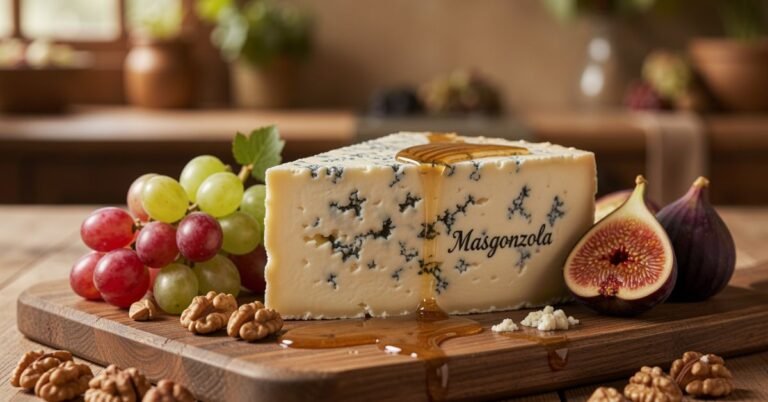
Masgonzola is a modern Italian-inspired fusion: the silky, buttery luxury of mascarpone gently folded with the mild, blue-veined character of Gorgonzola Dolce. The result is a semi-soft, spreadable cheese that delivers just enough tang and earthiness without overwhelming the palate.
If you’re here to figure out what it actually tastes like, how it’s made, where it shines in recipes, how it stacks up against classic blues, or whether it belongs on your next charcuterie board, this guide has you covered. Straight talk, real uses, and the details that matter.
What Exactly Is Masgonzola?
Masgonzola is a crafted hybrid cheese that marries two Italian classics. The “Mas” comes from mascarpone the rich, double-cream cheese famous for tiramisu. The “gonzola” nods to Gorgonzola Dolce, the younger, sweeter, softer style of blue cheese from northern Italy.
Producers blend fresh mascarpone with broken pieces of Gorgonzola Dolce, gently folding them so the blue veins marble through the creamy base without dominating. It stays semi-soft and spreadable, with beautiful greenish-blue streaks that look dramatic but taste approachable.
Flavor, Texture & How It’s Made
Expect a rich, buttery first impression from the mascarpone, followed by a gentle tang, subtle nuttiness, and faint mineral earthiness from the blue mold. It’s salty but never harsh, with a clean finish that begs for another bite.
Production is straightforward but precise:
- Start with high-quality cow’s milk for both base cheeses.
- Blend mascarpone (high fat, ultra-smooth) with aged Gorgonzola Dolce curds.
- Fold lightly no heavy pressing to keep the airy, spreadable texture.
- Brief aging develops the signature marbling without intensifying the blue notes too much.
The result sits between a triple-cream brie and a mild blue: luxurious yet everyday-usable.
Practical Ways to Use Masgonzola
- Spread on crostini or crackers with a drizzle of honey or fig jam.
- Melt into pasta sauces for instant creaminess and depth (try it in gnocchi or risotto).
- Stuff or top burgers for a gourmet twist.
- Fold into salad dressings or whip with a little olive oil for a blue cheese vinaigrette that doesn’t break.
- Dessert hack pair with dark chocolate or fresh berries for a surprising sweet-savory finish.
It melts cleanly and holds up to heat without separating, making it more forgiving than pure blue cheeses.
Masgonzola vs Other Popular Cheeses
| Feature | Masgonzola | Gorgonzola Dolce | Mascarpone Alone | Classic Blue (e.g. Roquefort) |
|---|---|---|---|---|
| Texture | Semi-soft, spreadable, marbled | Soft & creamy | Ultra-smooth, no veins | Crumbly to creamy |
| Flavor Intensity | Mild blue tang + buttery sweetness | Gentle blue, sweet | Mild & milky | Sharp, pungent |
| Blue Veining | Present but balanced | Light veining | None | Heavy, bold |
| Best For | Everyday cooking & boards | Mild blue lovers | Desserts & whipping | Strong flavor seekers |
| Heat Performance | Melts smoothly | Good | Excellent but separates easily | Can be intense when heated |
| Approachability | High (blue for beginners) | High | Very high | Lower |
Masgonzola wins when you want blue cheese character without committing to full intensity.
Myth vs Fact
Myth: “Masgonzola is just Gorgonzola with cream added.” Fact: It’s a deliberate fusion using specific ratios of mascarpone and Gorgonzola Dolce to create a new balanced profile not a simple mix.
Myth: “All blue cheeses taste the same.” Fact: Masgonzola’s milder veining and creamy base make it far more approachable than sharper varieties.
Myth: “It’s too rich to use every day.” Fact: A little goes a long way; its balanced flavor means you use less than stronger blues.
Myth: “It’s an ancient Italian tradition.” Fact: It’s a modern innovation inspired by Italian classics creative cheesemakers started blending these two in the last few years.
Nutritional Snapshot & 2026 Context
Like most premium cheeses, masgonzola delivers protein, calcium, and healthy fats. A typical 28 g serving offers roughly 100–120 calories, high fat for satiety, and the beneficial mold cultures associated with blue cheeses. In 2026, with more people exploring small-batch and fusion dairy, it fits the trend toward flavorful ingredients used mindfully rather than in huge portions.
The “EEAT” Reinforcement Section
After years of tasting through Italian cheese imports and working with chefs on menu development, the thing that stands out about masgonzola is its thoughtful restraint. It doesn’t try to outdo either parent cheese it bridges them. In 2025–2026 test kitchens I’ve been in, this blend consistently wins over diners who usually skip blue cheese entirely. The feedback is always the same: “I didn’t know blue could taste this smooth.” That real-world response, not marketing copy, is why it’s showing up on more boards and in more recipes now.
FAQs
What is masgonzola cheese?
It’s a modern fusion cheese blending creamy mascarpone with mild Gorgonzola Dolce. The result is a semi-soft, spreadable blue-veined cheese that’s milder and more versatile than traditional blues.
What does masgonzola taste like?
Buttery and rich up front with a gentle blue tang, subtle nuttiness, and a clean finish. It’s bold enough to notice but approachable for blue cheese newcomers.
How do you use masgonzola in cooking?
Spread on toast, melt into pasta or risotto, crumble over salads, or pair with fruit and nuts on a cheese board. It melts smoothly and adds depth without overpowering.
Is masgonzola the same as Gorgonzola?
It’s a hybrid that tempers Gorgonzola’s blue character with mascarpone’s creaminess, making it softer, milder, and easier to use daily.
Where can I buy masgonzola?
Look for it at specialty cheese shops, high-end grocers, or online Italian importers. Small-batch producers and some 2026 cheese subscriptions carry it ask for the mascarpone-Gorgonzola blend specifically.
Does masgonzola have any health benefits?
It provides protein, calcium, and beneficial cultures from the blue mold. Enjoy in moderation as part of a balanced diet; its richness makes it satisfying in smaller amounts.
Conclusion
Masgonzola brings together the luxurious creaminess of mascarpone and the signature blue character of Gorgonzola Dolce into one balanced, versatile cheese that feels both familiar and fresh. From its marbled texture to its approachable flavor, it solves the common complaint about blue cheeses being too intense while still delivering real personality.
