


Key Takeaways:
- Wiring diagrams are essential tools for diagnosing and repairing electrical issues in various systems.
- Interactive and automated wiring diagrams enhance efficiency and accuracy in troubleshooting.
- Understanding wiring diagrams empowers both professionals and DIY enthusiasts to perform safe and effective repairs.
Importance of Wiring Diagrams
In the world of repairs, whether it’s fixing your car, solving an issue with your HVAC unit, or handling home electrical systems, accurate diagnosis is crucial. This is where wiring diagrams prove indispensable. These visual representations serve as blueprints, illustrating the connections, pathways, and components within a circuit. When presented with a complex system, professionals and hobbyists turn to diagrams like the Cummins wiring diagram for precise information, making even the most complex repairs manageable.
Without clear schematics, troubleshooting electrical systems becomes a daunting task of guesswork, increasing the risk of overlooking faults or making costly mistakes. Wiring diagrams not only shorten repair times but also bring structure and confidence to the process, ensuring that repairs are both safe and effective for anyone who relies on them.
For both large-scale industrial contexts and at-home projects, wiring diagrams serve as silent guides. They allow the user to visualize concealed connections and understand interdependencies of components that are otherwise hidden beneath panels or behind walls. Whether updating an outdated installation or planning a new modification, referencing a wiring diagram is one of the most reliable steps in achieving efficient repairs.
By streamlining diagnostics and organizing information, these diagrams support a methodical approach, limiting downtime and reducing the chance of secondary issues. Consulting a detailed, manufacturer-supplied diagram can also help verify the authenticity of system architecture and catch subtle errors overlooked in generic documentation.
Components of a Wiring Diagram
A good wiring diagram employs a standardized set of symbols and conventions, providing a language that transcends brands and industries. Common elements include:
- Symbols for electrical components: Such as resistors, switches, fuses, relays, and bulbs. These shapes provide instant recognition of each element’s function.
- Interconnecting lines: These lines represent the physical wires in the system, drawn to show the connections, not necessarily the routing.
- Labels and designations: Each wire and terminal is typically labeled with colors, numbers, or codes, allowing users to cross-reference the diagram with actual components.
- Legend and notes: An accompanying legend explains the specific symbols used and may include extra details about connections or settings unique to the application.
Understanding these building blocks is the first step toward confidently using a wiring diagram, as they provide the foundation for clear communication in electrical work.
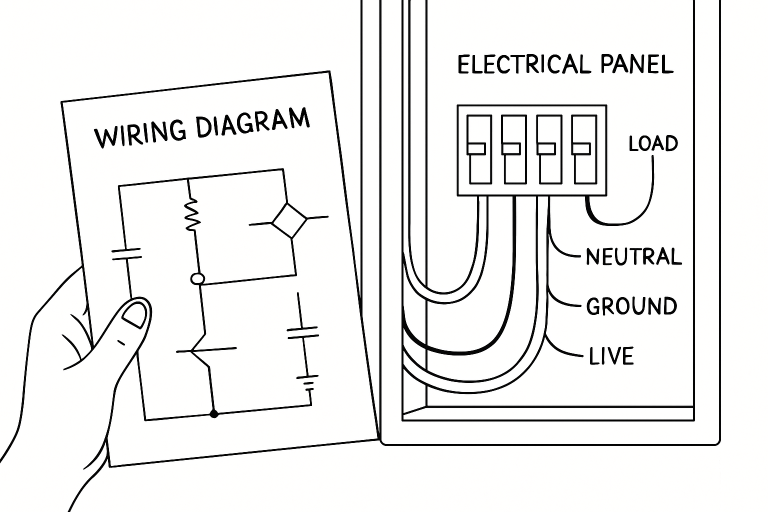
Reading and Interpreting Wiring Diagrams
Harnessing the power of a wiring diagram comes from learning to interpret the lines and symbols correctly. Here’s how to break it down:
- Identify symbols: Start by referencing the diagram’s legend to decode symbols. For example, a triangle might indicate a diode, while a crisscross represents a lamp.
- Follow the circuit’s flow: Electricity moves in a path. Trace power from the source (often marked as a battery or main supply) through switches, loads, and eventually to ground or return.
- Note connections and branches: See where wires split, connect, or return. Pay close attention to splices and junctions, which may be common sites for faults.
- Focus on color coding: Many diagrams use color designations that match the actual wire sheathing.
The more familiar you become, the faster you can spot errors, trace circuits, and predict how system changes will impact the whole.
Real-World Applications
Repair scenarios show just how vital wiring diagrams are in practice. Picture a car technician diagnosing a dashboard warning light. By referencing the relevant vehicle diagram, they can isolate the correct fuse, relay, or switch. Similarly, a homeowner using a wiring diagram to upgrade a light fixture ensures they avoid connecting hot and neutral wires incorrectly, which is a major safety issue.
Even in large-scale industrial settings, wiring diagrams support teams performing preventative maintenance or quickly restoring systems after faults. Industry standards recommend always referencing the latest diagram revisions before making changes, protecting both equipment and personnel.
In all these scenarios, wiring diagrams save time, reduce guesswork, and help ensure repairs restore full functionality, demonstrating their practical value.
Advancements in Wiring Diagram Technology
Technology continues to shape the usefulness and accessibility of wiring diagrams. Traditional paper schematics are evolving into interactive digital diagrams that let users click on components for troubleshooting advice, part numbers, or technical specs. For instance, SUN Collision Repair offers auto technicians wiring diagrams integrated with component data, making repairs more efficient and reducing mistakes.
Many platforms now feature cloud-based diagram libraries, searchable by make or model, enabling instant access to wiring information and revision updates. Such innovations are transforming the way electrical professionals and hobbyists approach repairs.
Benefits for DIY Enthusiasts
Wiring diagrams are not just for professionals they unlock repair capability for DIYers at every skill level. Access to accurate diagrams helps demystify electrical systems, empowering individuals to perform their own repairs and upgrades, from swapping outlets to fixing automotive sensors.
Whether learning from comprehensive PDF guides about basic wiring or exploring online tutorials, DIYers can move from uncertainty to confidence, armed with a roadmap for safe, effective work. Succeeding in these projects often inspires deeper exploration and skill-building.
Safety Considerations
While wiring diagrams are powerful, safety practices must always come first. Always disconnect power before investigating electrical issues. Utilize insulated tools, wear proper protective gear, and never hesitate to call an expert when confronted with unclear or hazardous situations. As the National Fire Protection Association (NFPA) frequently emphasizes, understanding a diagram doesn’t replace proper safety protocol or compliance with electrical codes.
Conclusion
Wiring diagrams bridge the gap between complex systems and effective repairs. By promoting accuracy, increasing efficiency, and ensuring safety, these diagrams remain essential at every level of electrical troubleshooting, from factory service bays to home workshops. Building expertise in reading and interpreting wiring diagrams unlocks capabilities for anyone wanting to maintain or upgrade their electrical systems and transforms the way everyday repairs are approached and completed.
